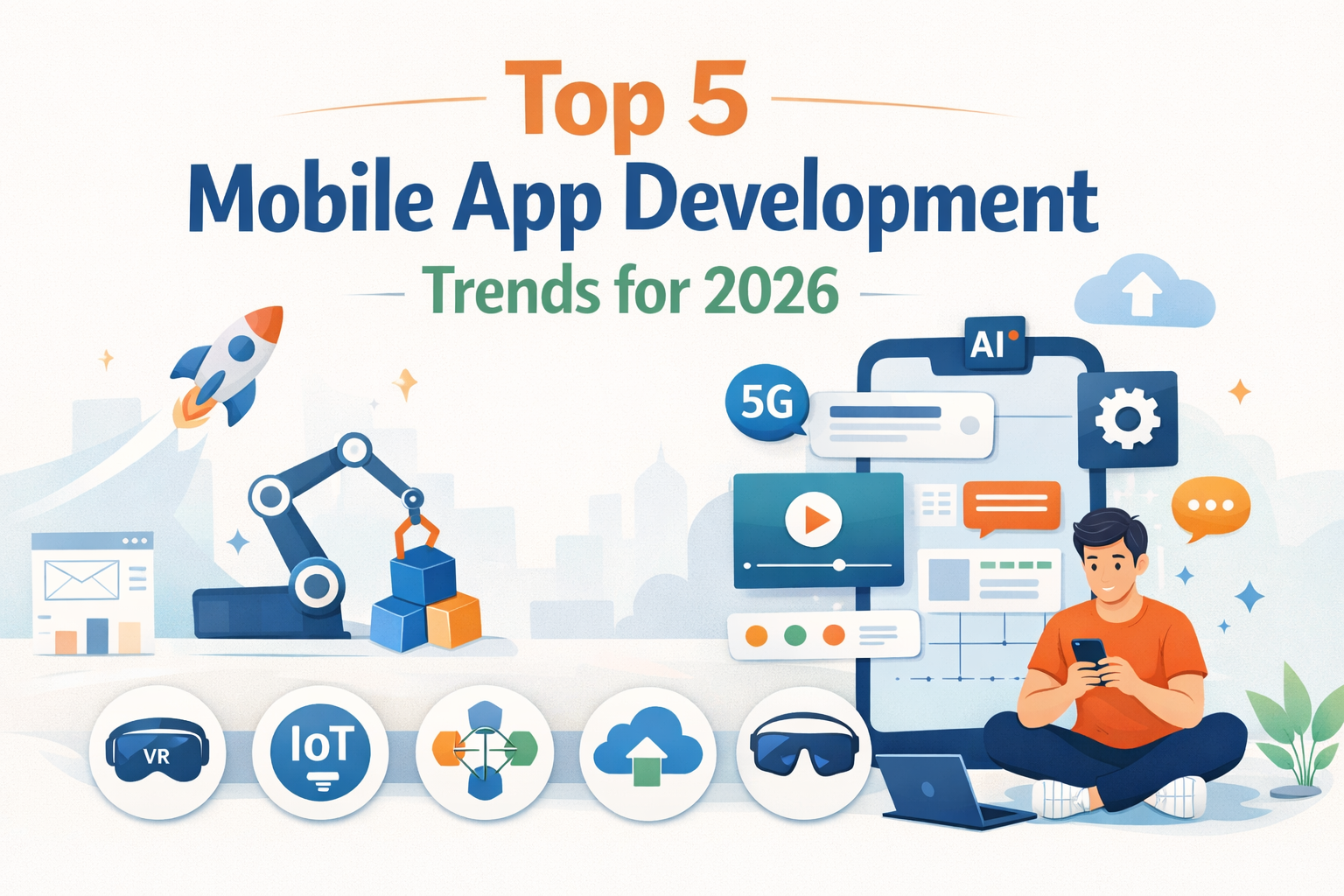
The mobile app development industry is experiencing rapid transformation as we move into 2026. With technological advancements accelerating at an unprecedented pace, developers and businesses must stay ahead of emerging trends to remain competitive. From artificial intelligence to cutting-edge frameworks, this year promises revolutionary changes in how we build and interact with mobile applications. In this comprehensive guide, we explore the top five mobile app development trends that are reshaping the industry and defining the future of mobile technology.
1. AI-POWERED MOBILE APPS: THE INTELLIGENCE REVOLUTION
Artificial intelligence has evolved from a buzzword to an essential component of mobile app development. In 2026, AI-powered mobile apps are transforming user experiences through personalization, predictive analytics, and intelligent automation. Machine learning integration enables apps to learn user behavior patterns, anticipate needs, and deliver hyper-personalized content in real-time.
Voice-enabled applications powered by advanced natural language processing are becoming mainstream, allowing users to interact with apps through conversational interfaces. AI-driven chatbots and virtual assistants are providing 24/7 customer support with human-like understanding. Additionally, computer vision capabilities are enabling innovative features like augmented reality filters, object recognition, and accessibility tools that make apps more inclusive. The integration of AI isn't just enhancing functionality—it's creating entirely new categories of intelligent mobile applications that adapt and improve with every interaction.
2. CROSS-PLATFORM DEVELOPMENT WITH FLUTTER AND REACT NATIVE
Cross-platform app development has reached new heights in 2026, with frameworks like Flutter and React Native dominating the landscape. These technologies allow developers to write code once and deploy across multiple platforms, significantly reducing development time and costs while maintaining near-native performance. Flutter's growing ecosystem and React Native's mature community support make them indispensable tools for modern app development.
The advantages extend beyond efficiency. Cross-platform frameworks now offer robust UI components, seamless native integration, and excellent performance optimization. Businesses are increasingly adopting this approach to reach wider audiences across iOS, Android, and even web platforms simultaneously. The unified codebase simplifies maintenance, accelerates updates, and ensures consistent user experiences across devices. As these frameworks continue to mature with better debugging tools and performance enhancements, cross-platform development is becoming the standard rather than the exception in mobile app development.
3. 5G MOBILE APP OPTIMIZATION: UNLEASHING ULTRA-FAST CONNECTIVITY
The widespread adoption of 5G networks in 2026 is revolutionizing mobile app capabilities. With download speeds up to 100 times faster than 4G and ultra-low latency, 5G mobile app optimization has become crucial for developers seeking to leverage this powerful infrastructure. This technology enables real-time data processing, seamless cloud integration, and bandwidth-intensive features that were previously impossible on mobile devices.
Apps optimized for 5G are delivering transformative experiences in areas like cloud gaming, where high-definition games stream without lag, and telemedicine, where real-time video consultations occur with crystal clarity. IoT mobile applications benefit enormously from 5G's ability to connect numerous devices simultaneously with minimal delay. AR and VR experiences are becoming more immersive and practical for everyday use. Developers must now consider 5G optimization as a core requirement, designing apps that can handle massive data transfers, support real-time synchronization, and provide instantaneous responses that users have come to expect in this new connectivity era.
4. SUPER APPS AND LOW-CODE DEVELOPMENT: DEMOCRATIZING APP CREATION
Two parallel trends are reshaping mobile app development in 2026: the rise of super apps and the proliferation of low-code development platforms. Super apps—comprehensive platforms that combine multiple services within a single application—are gaining traction globally. These all-in-one solutions integrate messaging, payments, shopping, transportation, and more, offering users unprecedented convenience and reducing the need for multiple specialized apps.
Simultaneously, low-code app development platforms are democratizing app creation, enabling businesses and even non-technical users to build functional mobile applications without extensive coding knowledge. These platforms use visual development interfaces, pre-built templates, and drag-and-drop components to accelerate development cycles. This trend is particularly valuable for businesses needing rapid prototyping or customized internal apps. The combination of super app ecosystems and low-code tools is creating a more accessible, efficient development landscape where innovation is no longer limited by technical barriers or resource constraints.
5. MOBILE APP SECURITY AND IOT INTEGRATION: PROTECTING CONNECTED ECOSYSTEMS
As mobile apps become more interconnected with IoT devices and handle increasingly sensitive data, mobile app security trends have become paramount in 2026. With cyber threats growing in sophistication, developers are implementing advanced security measures including biometric authentication, end-to-end encryption, blockchain-based verification, and AI-powered threat detection to protect user data and maintain trust.
IoT mobile applications are expanding rapidly, connecting everything from smart home devices and wearables to industrial equipment and healthcare monitors. This connectivity demands robust security protocols to prevent unauthorized access and data breaches. Progressive Web Apps (PWAs) are also contributing to this landscape by offering app-like experiences with enhanced security features and offline capabilities. Mobile commerce apps are implementing advanced fraud detection systems and secure payment gateways. As the Internet of Things continues to expand, the intersection of mobile app development and IoT integration will define how we interact with the physical world through our devices.
CONCLUSION: EMBRACING THE FUTURE OF MOBILE APPS
The mobile app development industry in 2026 is characterized by intelligent, connected, and user-centric innovations. AI-powered capabilities, cross-platform efficiency, 5G optimization, versatile super apps, and robust security measures are not just trends—they represent the foundation of modern mobile app development. Businesses and developers who embrace these technologies will be well-positioned to create compelling, competitive applications that meet evolving user expectations.
Whether you're exploring AI mobile app development, optimizing for 5G networks, or integrating IoT capabilities, understanding these trends is essential for success in the app development industry. The future of mobile apps is here, and it's more exciting, accessible, and transformative than ever before. Stay informed, adapt quickly, and leverage these mobile app development trends to build the next generation of innovative mobile solutions.